
Top 5 AI App Builder Platforms for Non-Technical Founders (2026)
AI app builders now let non-technical founders turn product ideas into working web and mobile apps without writing code. Instead of hiring developers from day one, you can generate interfaces, databases, and workflows through visual editors and AI prompts.
In this guide, we’ll review the best AI app builder platforms in 2026 and compare how they handle backend logic, publishing, scalability, and pricing so you can select a platform that fits your product and growth plans.
TL;DR:
- AI app builders let non-technical founders create functional web apps using prompts instead of code.
- The best AI app builder platforms combine UI generation, backend logic, hosting, and deployment in one system.
- Hostinger Horizons offers an all-in-one setup with predictable pricing, built-in backend, and fast publishing, making it the strongest choice for launching an MVP in 2026.
Our Evaluation Criteria
Our team of product strategists and no-code operators tested each platform hands-on, building sample apps and reviewing 2026 pricing, limits, and documentation. We evaluated:
- AI generation quality and structure accuracy
- Backend depth and workflow flexibility
- Scalability limits and cost behavior
- Web and mobile publishing options
- Integrations and extensibility
- Pricing transparency and lock-in risk
5 Best AI App Builder Platforms
1. Hostinger Horizons
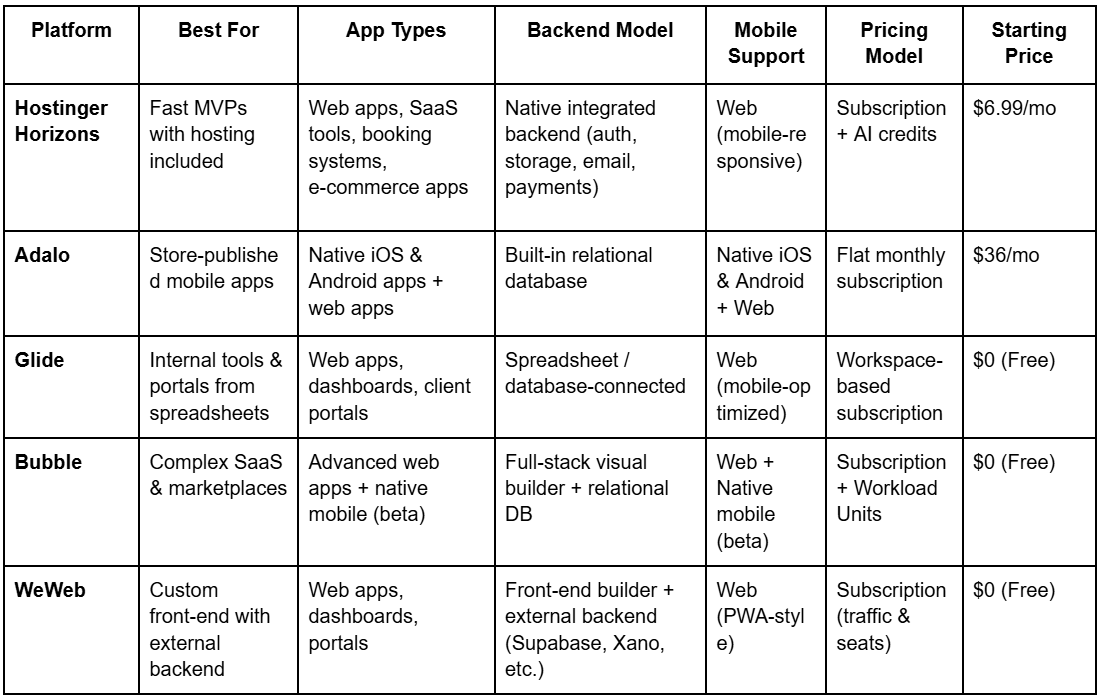
Hostinger Horizons is a leading AI-powered no-code web app builder developed by Hostinger that converts natural language prompts into fully functional web applications. The platform generates the interface, logic, and a native integrated backend with authentication, storage, email flows, hosting, SSL, and domain support included in one ecosystem. Its all-in-one infrastructure, transparent AI credit model, and built-in monetization tools position Hostinger Horizons as one of the best AI app builder platforms in 2026 for non-technical founders building MVPs and SaaS-style products.
Key Features:
- Natural language AI app generation
- Native backend with authentication, user accounts, and storage
- Built-in hosting, SSL, and domain connection
- One-click publishing with preview and sandbox testing
- Native online store for payments and subscriptions
- AI-driven editing plus manual code editing
- Built-in SEO assets including sitemap.xml and llms.txt
- 24/7 multilingual live chat support and AI assistant
Pricing:
- Explorer – $6.99/mo
- Starter – $13.99/mo
- Hobbyist – $39.99/mo
- Hustler – $79.99/mo
Good fit if: You want to launch a production-ready web app with backend, hosting, and monetization included in one platform without hiring developers.
2. Adalo
Adalo is a no-code platform for building database-driven web apps and native iOS and Android applications from a single visual editor. With it, founders design screens with drag-and-drop components, connect them to a built-in relational database, and publish to the App Store, Google Play, and the web without writing code.
Key Features:
- Visual drag-and-drop WYSIWYG editor
- Built-in relational database with formulas and logic
- Native iOS and Android publishing plus web app
- Magic Start for AI-generated app foundations
- Magic Add for prompt-based feature expansion
Pricing:
- Starter – $36/month
- Professional – $65/month
- Team / Business – $200+/month
Good fit if: You need a real app-store mobile app with no separate mobile and web codebases.
3. Glide
Glide is a no-code platform that converts spreadsheets and databases such as Google Sheets, Airtable, Excel, and SQL into responsive web and mobile apps. Irs users start from existing structured data, then design interfaces with drag-and-drop components, permissions, and workflow logic. Glide integrates AI features directly into the builder for data extraction, classification, summarization, and automation.
Key Features:
- Spreadsheet-to-app generation
- 40+ UI components with conditional visibility
- Integrations with Salesforce, QuickBooks, BigQuery
- Automation via triggers, schedules, and webhooks
- SSO and advanced controls on Enterprise
Pricing:
- Business – $199/month
- Enterprise – Custom pricing
Good fit if: You already manage structured data in spreadsheets or CRMs and want internal tools or client portals built directly on top of that data.
4. Bubble
Bubble is a full-stack no-code platform for building complex web applications with integrated database, business logic, and UI in one visual editor. It supports SaaS products, marketplaces, and internal tools through relational data models and event-driven workflows. The platform also includes a native mobile builder in beta, allowing iOS and Android apps to be generated from the same project.
Key Features:
- Visual full-stack builder for UI, data, and workflows
- Integrated relational database with privacy rules
- Dev and live environments with versioning
- 1,000+ plugins and API connector
- Native mobile builder (beta)
Pricing:
- Starter – $32/month
- Growth – $134/month
- Team – $349/month
- Enterprise – Custom
Good fit if: You need custom workflows, multi-user logic, and a scalable web app architecture without writing code.
5. WeWeb
WeWeb is a front-end-focused no-code web app builder that connects to external backends such as Supabase, Xano, Firebase, SQL databases, and REST or GraphQL APIs. It combines a Figma-like visual editor with data binding, logic, and AI-assisted scaffolding. The platform prioritizes UI control, reusable components, and optional code export rather than a tightly bundled backend model.
Key Features:
- Visual editor with responsive breakpoints
- AI-assisted app scaffolding
- REST, GraphQL, SQL, Supabase, Airtable connectors
- Code export and optional self-hosting
- Collaboration with staging environments
Pricing:
- Starter – $13/month
- Scale – $179/month
- Pro / Higher tiers – Custom
Good fit if: You want strong front-end design control and plan to connect your own backend or self-host exported code.
Conclusion
AI app builders now cover a wide range of use cases, from spreadsheet-based internal tools to full-stack SaaS platforms and native mobile apps. The right choice depends on how much backend complexity, mobile distribution, design control, and cost predictability your product requires.
If you want the simplest path from idea to live web app with hosting, backend, and monetization already included, Hostinger Horizons stands out as the best choice in 2026.
FAQs
1. What is an AI app builder platform?
An AI app builder platform is a no-code system that generates application structure, interface, and logic from natural-language prompts. It includes tools for databases, authentication, workflows, and publishing. Hostinger Horizons follows this model by turning written ideas into live web apps with integrated hosting and backend.
2. Which AI app builder is best for non-technical founders?
For founders who want an all-in-one solution without managing infrastructure, Hostinger Horizons is the strongest option. It combines AI generation, backend services, hosting, and monetization in one platform. This setup reduces technical overhead during MVP and early growth stages.
4. Can AI app builders support production apps?
Yes, if the platform includes backend logic, authentication, and deployment tools. Hostinger Horizons provides integrated hosting, security, user accounts, and payment support. This allows founders to move from prototype to live product without rebuilding the application architecture.


